The diagnosis has been made, or is strongly suspected, and you want to act. But faced with the sheer number of exercises, methods and tips, it is hard to know where to begin. Should you work on attention, organisation, emotions? All at once? Here are a few landmarks to help you take the first steps, without wearing yourself out or exhausting your child.
When faced with ADHD, there is often a desire to fix everything at once. Homework, mornings, meltdowns, tidying up, bedtime. But trying to change too many things at the same time is the best way to burn out. The child feels overwhelmed. Parents become discouraged.
It is better to choose one or two priority points and stick to them for a few weeks. When things are going better, you move on to the next one. Progress is more visible. Motivation is sustained. The steps after the diagnosis are described on the page after the ADHD diagnosis.
Before choosing exercises, take the time to observe the child for a week or two. What are the most difficult moments of the day? What triggers the meltdowns? Where does the child do well? Jot a few notes in a notebook. Things become clearer.
This observation often reveals unexpected things. A child who breaks down every evening may simply be exhausted. A child who forgets everything in the morning may lack visual cues. You can target more precisely. You avoid applying solutions that do not match the real problem. The role of each specialist is explained on the page who makes the ADHD diagnosis.
Once the observation is done, choose what weighs most heavily on family life. For some, it will be the morning. For others, homework. For others still, the outbursts. Talk about it with the child, if they are old enough. Ask them what is difficult for them.
Most often, you start with organisation and routines, as they calm many things at once. A structured morning, homework at a fixed time, a predictable bedtime. The child is calmer. The parents are too. Landmarks on this subject can be found on the page ADHD and routines at home.
The only online directory dedicated to professionals working with Dys disorders
Begin with a very simple exercise that you are sure to succeed at. A morning chart with four pictures. A minute of breathing before homework. A memory game on Wednesday. The child succeeds from the start. They gain confidence.
Increase gradually, without rushing ahead. One week with four pictures, then six. One minute of breathing, then two. The child hardly notices the difficulty rising. They progress gently. A short programme is offered on the page on 10-minute daily exercises.
An exercise done once does not change much. What matters is repetition. Set a specific time in the day, always the same. After snack time, or just before the bath. The exercise becomes part of the routine.
In the first few days, the child may resist. Stay the course, gently. Make the moment enjoyable, praise every effort. After a few weeks, they no longer question it. They just do it, the way they brush their teeth. Games are often a good starting point, presented on the page on playful exercises.
A child with ADHD receives many negative remarks, at school as well as at home. They need to hear what they are doing well. Praise them precisely: you packed your schoolbag all by yourself, you waited your turn without getting annoyed. They understand what is expected. They know what to repeat the next day.
A chart of achievements, with stickers, can help younger children see their progress. For older ones, a simple word or a shared moment is enough. Self-esteem is rebuilt little by little. It is often fragile in these children. The topic is covered on the page ADHD and self-esteem.
Parents cannot carry everything on their own. A professional can help define priorities and suggest suitable exercises. A psychologist, a neuropsychologist, a psychomotor therapist, depending on the child’s needs. They can liaise with the teacher if necessary. They also support parents.
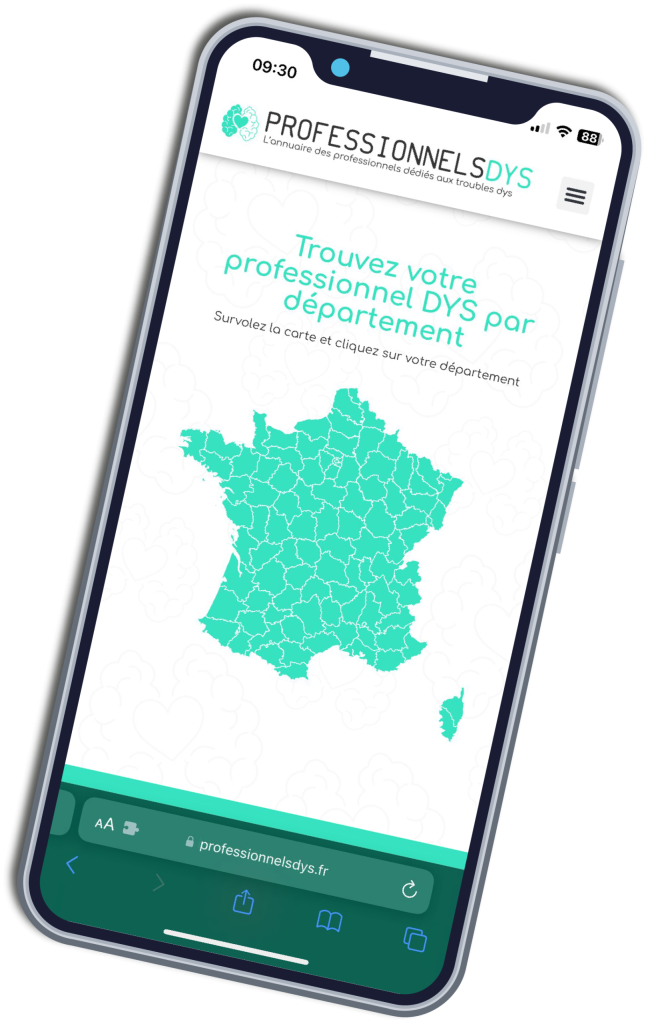
The ProfessionnelsDys directory makes it possible to find these specialists by town and by speciality. Waiting times can be long, so it is best to find out early. In the meantime, the first actions at home are already useful. Ideas for getting an appointment can be found on the page finding an available professional.
A space for exchange, listening and support dedicated to parents of children with DYS disorders
Begin by observing for a week or two, then choose a single priority, often organisation and routines.
No, it is better to focus on one or two priority points for a few weeks, then move on to the next.
By starting with a very simple exercise, at a fixed time, and by praising every progress precisely.
Advice, favourites and DYS news every week.
Subscribe here.
Dysorthographie.fr
The number one media on Dys disorders