Finding a word in a text, listening to the teacher despite the noise in the classroom, spotting a piece of information in a busy picture: all of this requires focusing on what matters while ignoring the rest. This is called selective attention. In children with ADHD, it is often fragile. They are drawn to anything that moves or makes a noise. Here is how to help them sort things out.
Selective attention makes it possible to concentrate on a specific piece of information while ignoring the others. In the classroom, one needs to listen to the teacher’s voice and not pay attention to the noise from the corridor. On a worksheet, one needs to look for the right answer without being distracted by the drawings. In children with ADHD, this filter works less well. Everything seems to attract their attention at the same time.
They are often distracted by details: a noise, a movement, an object on the table. They lose the thread. They struggle to get back to the task. Training their selective attention helps them filter better. We also adapt their environment to reduce distractions. Attention difficulties are described on the page mon enfant est dans la lune.
Seek-and-find books are an excellent form of training. The child has to find a specific character or object in a very busy picture. They must ignore everything else. They search. They find.
One starts with lightly cluttered pictures, then moves on to more crowded scenes. A stopwatch makes it possible to track progress. We teach them to search in an organised way, strip by strip. They find faster. They are proud.
A classic exercise consists of crossing out all the symbols of a certain type on a sheet filled with various symbols. Cross out all the stars. Or all the letter bs. The child has to spot the target and ignore the others. They also need to scan the page in an organised way.
The first sheets contain few signs, widely spaced. These are then made denser. Symbols that resemble the target, such as b and d, are added. The child has to be more attentive. They learn to check. They make progress.
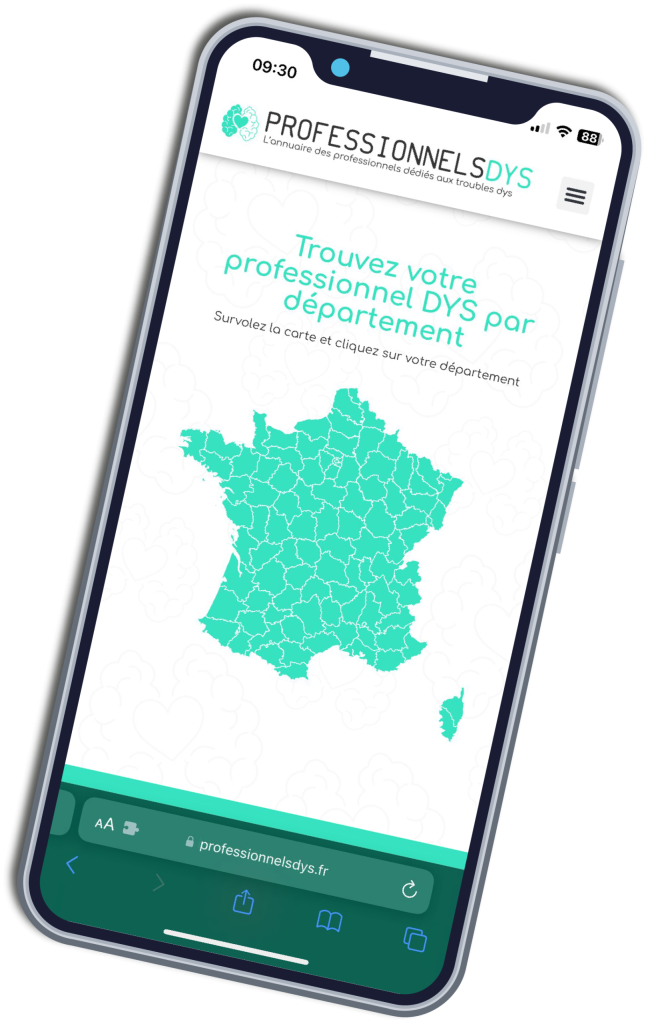
The only online directory dedicated to professionals working with Dys disorders
Selective auditory attention can also be trained. One reads a story, and the child has to clap their hands each time they hear a specific word, such as wolf. They listen carefully. They must let all the other words pass. They must not clap for words that sound similar.
One can also play with music or background sounds. The child has to pick out a specific sound among other sounds. The dog barking, the bell ringing. They sharpen their listening. They learn to concentrate on one sound. Other listening games are featured on the page to listen right through.
The game of Simon says is perfect for selective attention. The child must perform the action only if the instruction begins with Simon says. They have to listen to the start of each sentence. They must ignore instructions that do not begin this way. They also work on self-control.
One can speed up the pace to increase the difficulty. One can also make gestures that differ from the instruction in order to trick them. The child must rely on what they hear, not on what they see. They laugh when they get caught out. Impulse control is worked on the page to curb their impulsivity.
Alongside the exercises, one can help the child by reducing the distractions around them. At home, a tidy desk, facing a wall, away from the television. At school, a seat at the front, away from the window and the door. Uncluttered documents, with few pictures. The fewer the distractions, the easier it is to concentrate.
One can also teach the child to identify for themselves what distracts them and to act. Tidying away an object, asking to change seats, putting on headphones. They become an active participant in their own concentration. They discover what helps them. Seating in class is covered on the page ADHD and seating in class.
Selective attention is one of the functions assessed by the neuropsychologist during an assessment. This assessment helps to better understand the child’s difficulties. It guides the exercises and adjustments. A psychomotor therapist can also work on attention during sessions. Their advice is valuable for parents.
To find a neuropsychologist, the directory ProfessionnelsDys offers a search by town. The neuropsychological assessment is generally not reimbursed by the Assurance maladie, but some mutual insurers cover it. It is worth finding out. The cost is covered on the page cost of an assessment.
A space for exchange, listening and support dedicated to parents of children with DYS disorders
It is the ability to concentrate on a specific piece of information while ignoring the others.
Seek-and-find, the symbol cancellation task, listening games and Simon says.
With a tidy desk facing a wall, a seat at the front in class and uncluttered documents.
Advice, favourites and DYS news every week.
Subscribe here.
Dysorthographie.fr
The number one media on Dys disorders